
Common Issues Found During Fall Protection Inspections and How to Address Them
Knowing common issues found during fall protection inspections is vital to safety. In the 2025 fiscal year, OSHA reported that fall protection standards were cited for the most violations. For over a decade, falls have been one of the leading causes of injuries and fatalities in the workplace, most especially in construction environments.
However, just because fall-related violations have been occurring for years doesn’t mean they are inevitable. One of the keys to combatting these citations is conducting regular, thorough inspections of fall protection equipment. But what exactly should you look for during said inspections? And what should you do when you run into noncompliance issues?
In this article, we’ll explore the different types of fall protection systems and the equipment they are comprised of, common issues found during fall protection inspections, and how to effectively address these issues.
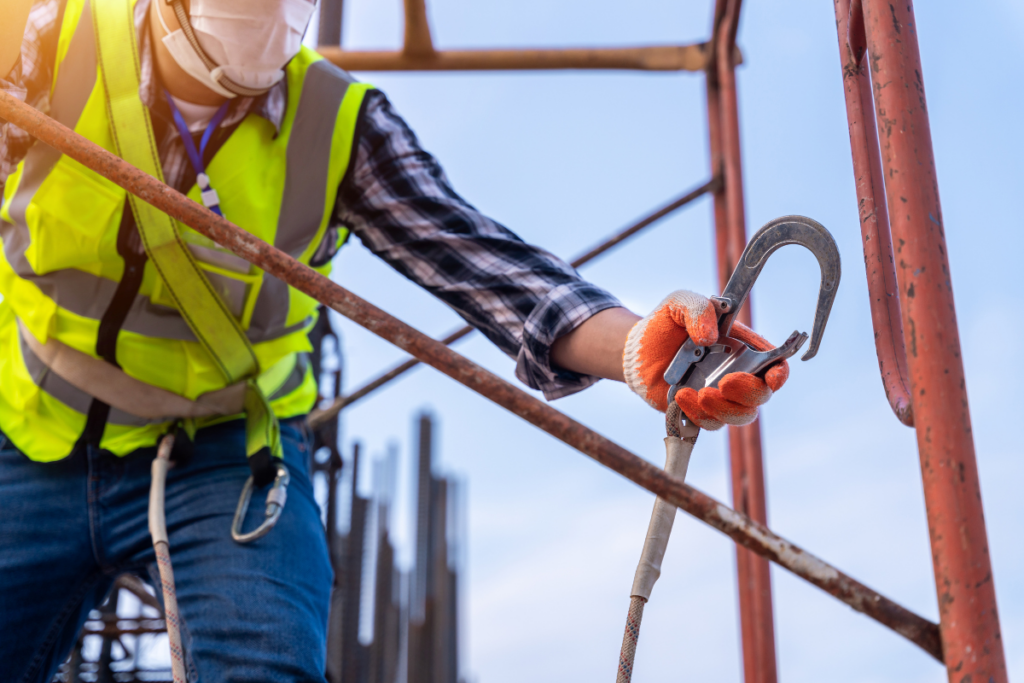
Fall Protection Systems and Equipment
Fall protection equipment can be used for a variety of tasks, such as:
- Positioning: stationary work that needs to be completed while leaning back
- Suspension: dynamic work that requires the ability to move up and down
- Retrieval: work that requires careful maneuvering to rescue people, typically conducted in confined spaces
There are two main types of fall protection systems:
Three of the Most Common Issues Found During Fall Protection Inspections
Not Attaching to Anchor Points
Too often, workers unknowingly attach to something other than a designated anchor point and end up paying the price for it. This is the usually the result of there not being enough anchor points provided for workers to attach to, or of provided anchor points not being clearly identifiable as such.
As the base of a fall arrest system, anchor points must be able to hold at least 5,000 lbs. for every worker attached. If a worker attaches to a structural element instead, they are not guaranteed the load-bearing capabilities of anchor points and thus are more likely to fall.
Damaged Personal Fall Arrest System (PFAS) Equipment
Damaged PFAS equipment is one of the most common issues found during fall protection inspections and is particularly dangerous because even damage that appears relatively minor can lead to catastrophic problems. What exactly “damage” looks like will vary for different components.
| Component | Damage |
|---|---|
| Stitching | Absent stitches; broken threads; loose stitches; discoloration from exposure to chemicals, UV rays, or heat |
| Webbing | Abrasions; brittleness, burn marks; cuts; discoloration from chemical or UV damage; fraying; hard and crusty spots; melting; swelling; tears |
| Hardware (D-rings, buckles, grommets) | Bending; corrosion; cracks; deformation; dirt/debris buildup; rust; warping |
| Labels | Illegible; missing |
Damage to stitching and webbing are especially common on the underside of harness straps, which are often overlooked during pre-use inspections.
Violating the Fall Protection Hierarchy
The last of the common issues found during fall protection inspections that we will go over in this article is not following the hierarchy of fall protection. The hierarchy goes as follows:
- Fall elimination
- Fall prevention
- Fall arrest
Essentially, this means that if you can, you should design the physical work space and employee workflows in a way that removes fall hazards entirely. If this is not feasible, the next thing to try is to use physical barriers and restraint systems to keep employees from finding themselves in a position where a fall is possible. Finally, employing equipment that stops falls as they occur should be a last resort.
The hierarchy is violated whenever an employee uses a PFAS for a task they could use a fall restraint system for, whenever equipment that could have been installed on the ground is installed on an elevated platform, or other such instances. Not following the hierarchy is dangerous because it exposes workers to a higher degree of risk than is necessary.
Addressing Common Issues
To make sure that workers only attach to elements specifically designed and rated for fall arrest loads, use ID tags to clearly mark anchor points as such.
One of the best way to address the common issues found during fall protection inspections listed above is by offering employees comprehensive fall protection training. As established, equipment is only effective if it is used correctly. Despite what some people might think, fall protection is skilled work, not mere common sense, and should be treated as such. In addition to providing initial training and hands-on practice, updated training should be provided annually and whenever equipment, procedures, and/or work conditions change.
Training for both administrators and field users will help negate instances of violating the fall protection hierarchy and of mismatching equipment type to performed task. Training also ensures workers know to never try to use the following as anchor points:
- Conduits
- HVAC ducts
- Pipes
- Rebar
- Scaffolding
Proper storage is another way to prevent equipment damage in particular. For fall protection equipment, this entails a storage area that is dry and free of sunlight, chemicals, heat sources, and sharp objects. Additionally, be sure to store damaged equipment awaiting repair separately from working gear.
To combat buildup of dirt or debris, follow the manufacturer’s recommendations for cleaning.
Our last recommendation for addressing common issues found during fall protection inspections is conducting regular inspections. According to OSHA, active fall protection system gear should be inspected before each use and immediately after any falls or near-misses. Additionally, both active and passive systems should be more thoroughly inspected at least once a year.
Regular inspections, especially of PFAS equipment, can feel a bit pointless because, if things go smoothly, they are more often than not pretty uneventful. However, don’t let this lure your into a false sense of security; slacking on inspections is seriously dangerous. After all, the longer the span of time between inspections conducted, the more opportunity issues have to fester and worsen. It is best to catch issues in their infancy and address them early on.
To make doing so as effortless as possible, use InspectNTrack to conduct inspections and store documentation. Compatible with Windows, Android, and iOS devices and posessing offline capabilities, InspectNTrack is the safety asset inspection software best suited for all your fall protection inspection needs. Contact us today and give it a try for yourself!