
This article will cover a general overview of first aid kits in the workplace, as well as the regulatory requirements for first aid kit inspection and maintenance
The main legislation pertaining to first aid kit inspection and maintenance requirements is OSHA 29 CFR 1910.151(b), which dictates that “adequate first aid supplies shall be readily available” in every workplace.
In addition to OSHA 29 CFR 1910.151(b), there are some other OSHA standards concerning first aid kits for specific industries and settings, such as logging, shipyards, marine terminals, longshoring, and construction.
Though OSHA hasn’t officially adopted ANSI/ISEA Z308.1, it points to that standard as a good reference for what to look for during first aid kit inspection and maintenance service. The most recent iteration of ANSI/ISEA Z308.1, called ANSI/ISEA Z308.1-2021, went into effect in October of 2022 and outlines what supplies are needed in the two classes of first aid kits.
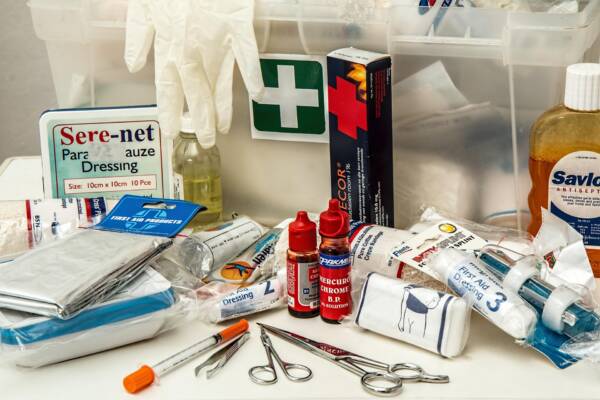
Class A kits are used in low-hazard workplaces that generally deal with common injuries (ex. offices), while Class B kits are found in higher-hazard environments where injuries tend to be more complex (ex. construction sites).
Everything that is included in a Class A kit is included in a Class B kit, but Class B kits tend to carry higher quantities of supplies—and even carry a couple supplies not found in Class A kits.
| Type of supply | Quantity in Class A kits | Quantity in Class B kits |
|---|---|---|
| Adhesive bandage | 16 | 50 |
| Adhesive tape | 1 | 2 |
| Antibiotic application | 10 | 25 |
| Antiseptic | 10 | 50 |
| Burn dressing | 1 | 2 |
| Burn treatment | 10 | 25 |
| Cold pack | 1 | 2 |
| CPR breathing barrier | 1 | 1 |
| Eye covering | 2 | 2 |
| Eye/skin wash | 1 (1 fl. oz. bottle) | Class B kits are required to have 4 fl. oz. total of eye/skin wash. This can be accomplished with 1 bottle holding the entire 4 fl. oz. or multiple smaller bottles that amount to 4 fl. oz. total. |
| First aid guide | 1 | 1 |
| Foil blanket | 1 | 1 |
| Hand sanitizer | 10 | 20 |
| Medical exam gloves | 2 pairs | 4 pairs |
| Roller bandage (2 in.) | 1 | 2 |
| Roller bandage (4 in.) | 1 | |
| Scissors | 1 | 1 |
| Splint | 1 | |
| Sterile pad | 2 | 4 |
| Tourniquet | 1 | |
| Trauma pad | 2 | 4 |
| Triangular bandage | 1 | 2 |
One of the expectations of first aid kit inspection and maintenance is that you will have enough kits and they will be of the appropriate class. To determine what class of kits you need and how many, conduct regular, thorough workplace risk and hazard assessments.
Consider the complexity of both the physical workspace and of the work being carried out. Also take into account the size of your workplace and workforce. Generally, the larger and more complex an operation is, the more first aid supplies that will be needed.
When and How to Conduct First Aid Kit Inspection and Maintenance Tasks
Unfortunately, OSHA also does not lay out specific inspection and maintenance intervals. OSHA does specify that it expects kits to be accessible and adequately stocked, and for supplies to be up-to-date and undamaged. Therefore, you should conduct first aid kit inspection and maintenance services as frequently as is needed to meet those criteria; This will vary depending on the specifics of your workplace—what kind of environment it is, how large the workforce is, how frequently first aid is needed, etc.
Generally, it is agreed upon among safety professionals that kits should be inspected, and restocked if necessary, at least once a month, but absolutely no less frequently than once every three months. For especially high-risk workplaces, weekly inspections are ideal.
If your workplace requires Class B kits, it likely also requires more frequent inspections.
When performing first aid kit inspection and maintenance tasks, verify that all of the contents that is expected to be in the kit is, and in the correct quantities. Make sure each supply is undamaged and throw out those that are soiled, broken, partially used, or expired. Be sure to promptly replace any supplies thrown out.
If your workplace needs additional supplies to address industry-specific hazards, ensure they are present and in good condition.
Make sure that every product is in its proper place. Consistency is important so that employees know what to expect when they open the kit. Seconds spent rifling through a disorganized kit are potentially critical moments wasted.
Of course, it is also vital to check that kits are in clearly visible and easily accessible locations. Don’t forget to verify that the cabinet, bag, or other container housing the first aid supplies is in working condition as well, including any latches or zippers.
How Regular First Aid Kit Inspection and Maintenance Ensures Compliance
The purpose of OSHA is to prevent workplace injuries and swiftly address ones that do occur. Oftentimes, a first aid kit is the first line of treatment when injuries occur. Therefore, making sure that the right materials are available at all times is crucial to creating the safest work environment possible.
In addition to putting employees at increased risk of physical harm, ignoring OSHA requirements surrounding first aid kits puts you at risk of being subjected to the following:
- Fines
- Lawsuits
- Reputational damage
- Close surveillance from OSHA
Not only does compliance help you avoid all of that mess, it actually boosts worker productivity by providing employees with peace of mind knowing their well-being is valued.
Of course, you will only know if your first aid kits are non-compliant if you are regularly checking them. This is why routine first aid kit inspection and maintenance is so important!
However, staying on top of inspections is not always as easy as you might hope. Workplaces can get busy and you may find yourself thinking, “I checked our first aid kits last month and they were fine; What are the chances anything has changed in just a month? I don’t have time to inspect each kit today.” You may not even think any of these things at all; You may just completely forget about monthly inspections!
This is where InspectNTrack comes in. A customizable asset inspection system, InspectNTrack makes delegating easier by offering you the ability to assign inspections. Additionally, InspectNTrack can automatically send reminders when inspections are due, making sure you and your team never miss one.
First aid kit inspection and maintenance services are extremely important in keeping employees safe and they don’t have to be a burden. Let InspectNTrack lighten your load today!