
In this article we will cover the components of Fire and Life Safety Systems: What they are and what do they do.
What are fire and life safety systems?
Fire and life safety systems are made up of different components, all of which further the goal of fostering an environment that minimizes two things:
- The risk of emergencies (including fires) occurring
- The effects emergencies have on both buildings and occupants when they do occur
Whether a component is intended to prevent, detect, or suppress fires, each one strengthens the barrier between life and death.
Many people think of only fire alarms or ceiling sprinklers when they hear the phrase “fire and life safety systems,” but these systems are actually a lot more complex than you might think. Let’s take a look at the various systems and pieces of equipment that make up fire and life safety systems.
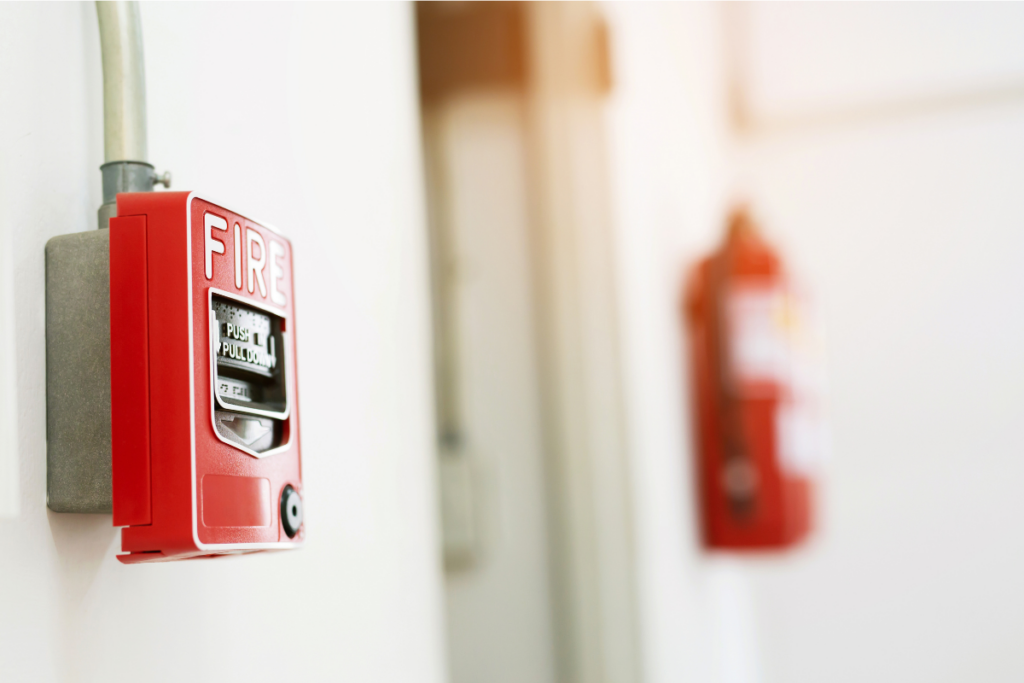
Elements of fire and life safety systems
Alarm systems
Alarm systems might be comprised of the following:
- Fire alarms (both manual and automatic)
- Malfunction alarms
- CO2 detectors
- Heat detectors
- Smoke detectors
- Water flow switches
- Mass warning systems
Though they are not alarms themselves, detectors are an important part of the alarm system and are commonly connected to fire alarms.
Often, a building’s alarm system is the first to realize when something is amiss, meaning having a properly maintained alarm system is vital for fire safety.
Fire extinguishers
Fire extinguishers are units of fire and life safety systems which aim to address smaller fires.
There are numerous kinds of extinguishers that target distinct kinds of fires, as explained below:
| Type of fire | Materials involved | Type(s) of extinguisher(s) used to put out this type of fire |
|---|---|---|
| Class A | Combustible materials | Water, foam |
| Class B | Flammable gases and liquids | Foam, CO2, dry chemical |
| Class C | Electrical equipment | CO2, dry chemical |
| Class D | Flammable metals | Dry powder |
| Class K | Fats and cooking oils | Wet chemical |
Fire suppression systems
Here is a chart detailing the types of suppression systems, each of which utilizes an agent to give building occupants more time to safely evacuate and to decrease the amount of damage a fire is able to inflict on people and property:
| Type of system | Description | Facilities these systems may be found in |
|---|---|---|
| Water | Commonly referred to as just “sprinklers”
Most widely used type |
Commercial buildings
Offices Warehouses |
| Water mist | Inflicts less water damage than water sprinklers
Water is atomized |
Historic buildings
Libraries Museums |
| Foam | Smothers fires by cutting off access to oxygen and absorbing heat | Aircraft hangers
Chemical storage facilities Power plants |
| Dry chemical | Interrupts the chemical reaction of fire by coating the fuel with powder
Best for locations where access to water is limited or where the conductivity of water would worsen fires |
Freezer rooms
Loading bays Outdoor balconies |
| Wet chemical | Liquid turns into foam on contact with cooking oils and fats | Food trucks
Marine galleys Restaurants |
| Carbon dioxide | Suffocates fires with gas
Primarily used in facilities storing sensitive equipment and settings that are particularly susceptible to water damage |
Engine rooms
Flammable liquid storage rooms Generator rooms |
| Clean agent | Put out fires without leaving behind any residue using gaseous agents | Computer rooms
Data centers Hospitals |
| Aerosol | Disrupts the chain reaction of a fire by releasing heat-absorbing salt particles
Best for smaller, enclosed spaces |
Electrical cabinets
Lithium-ion energy storage rooms Parking garages |
Note that if your building houses a commercial kitchen, a kitchen fire suppression system in particular must be a part of your fire and life safety systems.
A kitchen fire suppression system is made up of not only a potassium-based wet chemical suppression system, but also at least one wet chemical fire extinguisher in the kitchen area.
To learn more about these and other elements of a commercial kitchen exhaust system, check out our article on NFPA 96.
Fire pumps
Having a fire pump is essential if your fire and life safety systems are water-based. Pumps increase a water source’s pressure, and thus are typically used in facilities such as storage warehouses and high-rise buildings, which tend to need more pressure than a typical building.
There are two main kinds of fire pumps:
Backflow preventers
Backflow preventers keep contaminants in your building’s non-potable water source from entering your town’s public drinking water supply. What kind of preventer your building needs depends on how intense the risk posed by the cross connection of these systems is.
While the most commonly used backflow preventers are Double Check Valve Assemblies (DCVAs) and Reduced Pressure Zone Assemblies (RPZAs), the most effective type is actually Air Gaps (AGs). Some additional types of backflow preventers are:
- Atmospheric Vacuum Breaker Assemblies (AVBs)
- Pressure Vaccuum Breaker Assemblies (PVBs)
- Double Check Detector Assemblies (DCDAs)
- Reduced Pressure Zone Detector Assemblies (RPZDAs)
Note that DCDAs are essentially DCVAs but with a bypass meter that monitors incidental water use and low flows. The same goes for RPZDAs and RPZAs.
Passive fire protection systems
These systems are made up of the following:
- Fire doors: inhibit the spread of fire and smoke
- Dampers: installed in air ducts to prevent smoke, debris, and other products of combustion from traveling through air distribution systems (air-conditioning, heating, ventilation)
- Emergency exits and lighting: provide increased visibility during emergencies and clearly illuminate path to exits
Fire aid kits
Though they are certainly not as technologically intensive as some of the other parts in fire and life safety systems, aid kits are extremely useful when it comes to addressing minor injuries like scrapes or burns.
NFPA standards relating to fire and life safety systems
For more information on standards for the installation, inspection, testing, and maintenance of various components of fire and life safety systems, consult the standards listed below:
| Components | Relevant NFPA standards |
|---|---|
| Alarm systems | NFPA 72 |
| Fire extinguishers | NFPA 10 |
| Water suppression systems (sprinkler systems) | NFPA 13, NFPA 25 |
| Water mist suppression systems | NFPA 750 |
| Foam suppression systems | NFPA 11 |
| Dry chemical suppression systems | NFPA 17, NFPA 33 |
| Wet chemical suppression systems | NFPA 17A, NFPA 96 |
| CO2 suppression systems | NFPA 12 |
| Clean agent suppression systems | NFPA 2001 |
| Aerosol suppression systems | NFPA 2010 |
| Fire pumps | NFPA 20, NFPA 25 |
| Backflow preventers | NFPA 13, NFPA 25 |
| Kitchen fire suppression systems | NFPA 96 |
| Fire doors and dampers | NFPA 80 |
| Emergency exits and lighting | NFPA 101 |
Keeping fire and life safety systems up to code
The elements listed above all work together to keep people and property safe from myriad emergencies. In order to do this, however, fire and life safety systems require regular upkeep, including inspections, testing, and maintenance. Even if you have all of the “right” equipment installed, it is your duty as a building owner to continually check that your building’s fire and life safety systems are functional and up to code at all times.
However, just because regular upkeep is important doesn’t mean it has to be a hassle. For any and every system component and piece of equipment, InspectNTrack offers flexible and easy-to-use inspection software. Contact us today to learn more!