
AED Readiness: Lessons From a School Tragedy and How Inspections Prevent Failure
In August 2024, 14-year-old Landon Payton collapsed during gym class at Marshall Middle School in Houston ISD. He was rushed to the hospital and later died. In the aftermath, reporting and records prompted a painful question: was the AED ready—and did it work when it was needed most?
According to news reporting based on inspection records, the AED in the gym had electrode pads that were flagged as expired during a May inspection—months before the emergency. While the district did not confirm whether the device functioned during the incident, the family’s attorney and educators’ representatives alleged the AED was not working at the critical moment. The broader concern was that this wasn’t an isolated risk: reports indicated numerous AEDs across the district were missing, malfunctioning, or had expired components around that time.
In response, Texas lawmakers passed Senate Bill 865, known as the “Landon Payton Act,” aimed at strengthening cardiac emergency preparedness in public schools through planning and training requirements. The details vary by district, but the takeaway is universal: AED Readiness isn’t a box to check—it’s a life-safety system that must work on demand.
Why AEDs “fail” in real emergencies
When people think “AED failure,” they often imagine a dramatic hardware breakdown. In practice, the most common causes are simple, predictable, and preventable:
Expired electrode pads (gel dries out; adhesion and conductivity can suffer)
Weak or expired batteries
Missing rescue kit items (scissors, razor, gloves, barrier mask)
A status indicator that isn’t checked consistently
Unclear ownership (nobody assigned to fix failures and verify completion)
This is exactly why AED Readiness depends on more than owning the device. It depends on disciplined inspection and follow-through.
AED Readiness checklist: what to inspect every time
A strong program uses a standardized checklist that makes “pass/fail” unambiguous. Your AED Readiness checks should typically include:
Status indicator shows “ready”/normal (per manufacturer)
Pads present (correct type, sealed packaging)
Pad expiration date is valid (not expired and not near-term)
Battery status is valid (or battery expiration date is valid)
Rescue kit is complete (gloves, barrier mask, scissors, razor, towel)
Cabinet/alarm access works and signage is visible
Location confirmation (device is where maps and emergency plans say it is)
Damage check (cabinet, case, connectors, and seals intact)
If your organization has multiple AED models, make the checklist model-specific. Consistency is great—but correctness is better.
This is also where many programs miss the point: the inspection is not the goal. AED Readiness is the goal.
How often should you verify AED Readiness?
Many organizations perform monthly readiness checks, and some do more frequent checks in high-traffic, high-risk, or public-facing areas. The right cadence depends on your environment, device type, and internal policy—but the wrong cadence is “whenever we remember.”
A practical approach that improves AED Readiness quickly:
Establish a baseline inspection frequency (often monthly)
Increase frequency for devices exposed to temperature swings, public access, or frequent movement
Add “extra checks” after events (storms, renovations, relocations, vandalism, or reported issues)
Whatever you choose, the most important factor is that the schedule is automatic and the responsibility is assigned.
The missing piece: closing the loop on failures
A pad expiration flagged in an inspection log doesn’t prevent tragedy unless someone replaces the pads—and someone else verifies they were replaced.
That “close-the-loop” discipline is the heart of AED Readiness:
A failed inspection must create a corrective task
A responsible person must be assigned
The fix must be tracked to completion
Evidence or verification should be required (photo, serial/lot, sign-off, etc.)
Overdue actions must escalate, not disappear
If failures can sit unresolved for weeks or months, the program can look “active” while devices remain unready.
How InspectNTrack supports AED Readiness
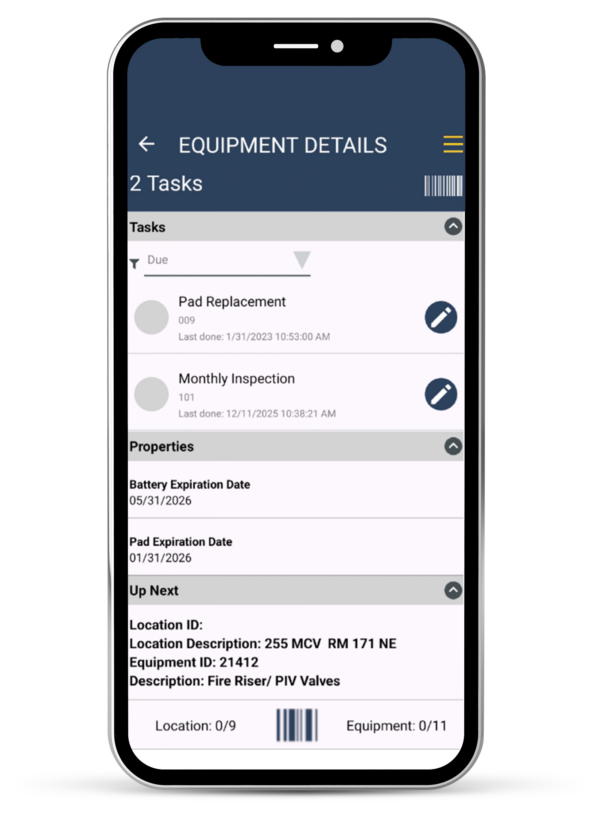
Think of digital inspection management as the scaffolding that keeps the human process from drifting. InspectNTrack supports AED Readiness by making it hard for common failure chains to persist.
Recurring inspection schedules so checks happen on time (and don’t rely on memory)
Mobile, standardized checklists so inspections are consistent across staff and locations
Pass/fail logic that forces attention to critical items (pads, batteries, status indicator)
Corrective actions that stay visible until resolved (no lost sticky notes or emails)
Accountability trails showing who inspected, what they found, and what was fixed
Reporting that helps leadership spot patterns (which sites are slipping, which devices are repeatedly failing)
In other words, InspectNTrack helps teams build AED Readiness as a system, not a hope.
What any organization can do this week to strengthen AED Readiness
If you want a high-impact improvement that doesn’t require a big project:
Inventory every AED (location, model, serial, cabinet type)
Document pad and battery expiration dates in one place
Standardize your checklist and train inspectors on what “fail” means
Assign ownership for fixes (and a backup owner)
Set escalation rules for overdue corrective actions
Audit a sample (pick 5 devices at random and verify the records match reality)
Even small improvements here meaningfully reduce the chance that a device will be present—but not functional.
Because in a cardiac emergency, AED Readiness isn’t a “nice to have.” It’s the difference between a response that helps and a response that fails.