
In this article, we’ll mainly focus on providing you with a fire hose cabinet inspection checklist that is fit for monthly visual inspections, but we’ll also touch on some important things to remember in preparation for professional annual inspections as well.
There are three types of fire hose cabinets:
- Recessed cabinets: Best suited for areas continually exposed to high levels of traffic or where minimal obstructions are necessary, recessed cabinets are set directly into a cavity within a wall.
- Semi-recessed cabinets: Only partially set in wall, semi-recessed cabinets protrude slightly, making them ideal for areas where space is limited but installing a fully recessed cabinet would be too intensive.
- Surface-mounted cabinets: Optimal for buildings with walls made of materials that make recession impractical (such as block or concrete), surface-mounted cabinets stick out the most of the three.
In order to comply with the Americans with Disabilities Act, both recessed and semi-recessed cabinets whose leading edges are between 27–80 inches from the floor are prohibited from protruding more than 4 inches into a path of travel.
Regardless of type, each cabinet houses a fire hose, a nozzle, and a rack or reel, so the contents of a fire hose cabinet inspection checklist will not vary much between cabinet types.
Fire hose cabinet inspection checklist
To start off your inspection, verify the contents of the cabinet. Is everything that is supposed to be in the cabinet (such as the fire hose, nozzle, rack or reel, etc.) present?
Next, check the cabinet’s signage for visibility and legibility.
Now, it’s finally time to crack the cabinet open and get to work! Below is a chart detailing not only the components that you should inspect, but what you should inspect them for as well.
| Inspection item | What to check |
|---|---|
| Cabinet | Physical damage (rust, dents, cracks, etc.) on or debris in cabinet
Visibility and accessibility/obstructions Proper label identification Smooth opening, closing, and latching of door Properly functioning locks Cracked or cloudy glass *If cabinet is break glass style, verify that both striking device and instructions are attached to the cabinet |
| Hose | Cracks, cuts, abrasions, burns, signs of chemical exposure or vermin, mildew, rot, mold
Water left in the hose immediately below valve connection |
| Nozzle | Damage or blockage
Water flowing freely from nozzle at correct pressure In closed position Ability to properly open and close Attached to hose |
| Rack | Secure and unobstructed rack nipple
Ability to easily swing out of cabinet Hose folded correctly over rack pins Properly mounted nozzle clip |
| Reel | Secure and stable mounting brackets
Ability to easily swing out of cabinet Hose neatly wound on reel Damage or denting on reel |
| Valves | Leakage
Correctly operating control valve Water supplied to angel hose valve Properly sized handwheel Handwheel fitted to valve |
The last item on your fire hose cabinet inspection checklist is confirming that the cabinet’s inspection tag and log of inspection and maintenance services are up to date.
Reels vs. racks
Exactly how your fire hose cabinet inspection checklist will look depends on whether your hose is wound around a reel or folded on a rack.
Let’s take a look at the differences between reels and racks:
Reels are cylindrical spindles used to hold lengths of non-collapsible hose. The most common type of reel is a manual one, where the user must pull the entire hose off the reel before water starts to flow through it. However, continuous flow reels, which allow water to flow even when the hose is still being unwound, also exist.
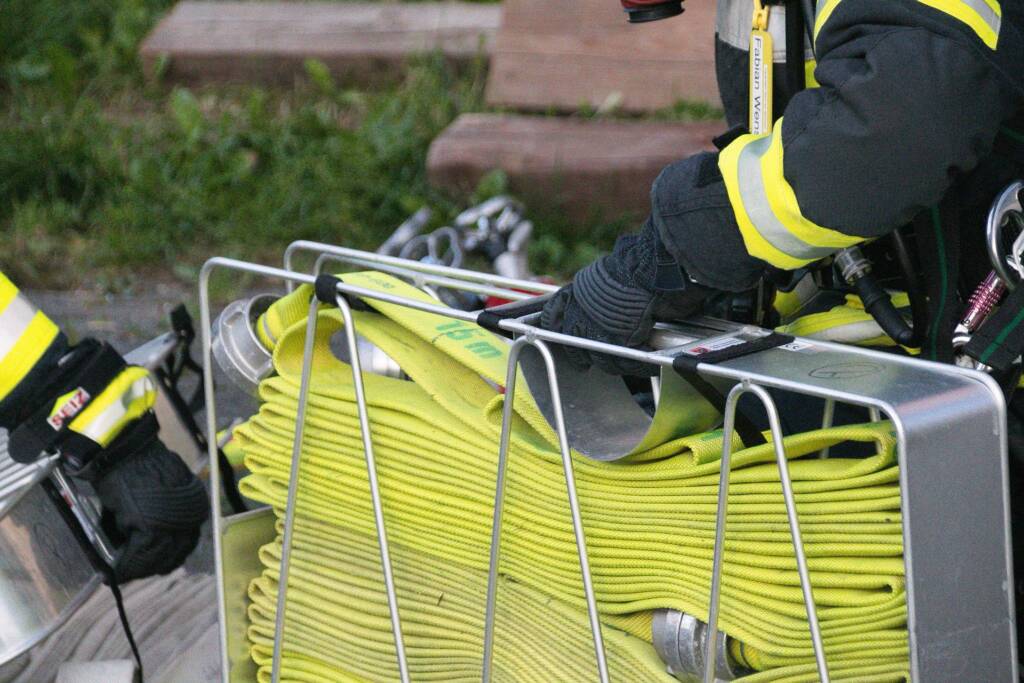
Racks, on the other hand, typically use pins to compactly hold a folded, collapsed hose. Other kinds of racks, such as saddle or hump racks, do not use pins and instead simply act as cradles for hose. While pin racks are semi-automatic, saddle and hump racks are both completely manual.
Hoses only need to be completely unwound or unfolded during their annual inspections. For hoses stored on pin racks, it is important that they be re-racked in a way that prevents cracking (in other words, the folds need to be in new spots).
Consistency in fire hose cabinet inspection checklists
Overall, when conducting a fire hose cabinet inspection, you will want to ensure that all components are accessible, properly labeled, and free of damage, corrosion, or leakage. Be especially aware of the space around your cabinet, as inaccessibility is one of the most common reasons that cabinets fail inspections.
To make sure that inspections go as smoothly as possible, opt for a digital platform to house both your fire hose cabinet inspection checklist and each inspection’s collected data. At InspectNTrack, we offer software that guarantees consistency and standardization, in turn providing clearer insights into problematic inspection patterns.
Our software is also fit to host data from a variety of kinds of inspections. So, if you decide to pair fire extinguisher and fire hose cabinet inspections together for the sake of convenience, for instance, you will only have to carry one device to conduct both inspections, not multiple clipboards. To learn more, request a demo from us today!